One of the things that I find so daunting about summer school is the brevity of it. The schedule is great -- the kids are here for a little under 3 1/2 hours and then I (supposedly) have the rest of the afternoon and evening. (Now, getting myself out of the building to do other things is another story altogether...)
What I lament, though, is the difference between this and the start of a regular school year. In September, we start the school year together slowly. We follow the Responsive Classroom approach and build our routines together -- we make mental images, we talk about what things will look like, what they will sound like, then we practice. We build our expectations and our community together, so that by the six week mark, we have our routines well set and can continue to get into some of the other work of first grade.
In Summer School, though, we can't do that. We have three weeks. Fifteen days. Forty-five hours.
I find it an interesting mental challenge to figure out how to create some of the necessary routines together, to choose some of the non-negotiables about how the classroom will be run, and figure out how to build that together -- but make it quick and dirty.
I'm not quite sure I have it down pat -- in fact, I'm quite sure I don't -- but this class sure does get excited about coming into the classroom and having Morning Meeting first thing every day. ♥
Wednesday, July 30, 2008


Monday, July 28, 2008
first day jitters...
Every summer, without fail, I start having dreams about the first day of school. In my normal, waking, sane mind, I'm slightly nervous, but always looking forward to meeting and getting to know a whole new group of young, interesting human beings that will end up holding my heart in a very real way.
My subconscious, however, has a whole other issue. It is afraid. Very afraid. It gives me dreams... it thinks back to my first year of teaching when I had a much, much harder time controlling the classroom and it turns that into dreams.
Usually I wake up and am full of relief that it was only a dream. But last night it tricked me! In the middle of a dream where I was saying things over and over again and children weren't listening at all, my dream self said in despair, "And this time it isn't even a dream!"
But it was.
I wonder why, though, that this is the most deep-seated fear that my subconscious holds as a teacher. It's never that I won't build a relationship with a student, or they won't engage with the curriculum, it's that I somehow won't have built the routines with the students and the classroom will be out of control.
I imagine it really does come down to what my first couple of years of teaching were like. It took me a good two years to start to feel like I had a better handle on classroom management, and several more still before I got to this:
teacher/administrator: Well, [name of student] is, um... well, they're a little bit challenging.
me: *smile* Oh, bring it on. I am going to adore them!
Interesting, though, that after twelve years of teaching, and three or four summer school classes, and I'm still full of butterflies on the first day.
In spite of my nerves, though, today was a brilliant first day at summer school. The kids are nervous, adorable, and eager. I can't wait to learn more about them... tomorrow we start Writing Workshop!
My subconscious, however, has a whole other issue. It is afraid. Very afraid. It gives me dreams... it thinks back to my first year of teaching when I had a much, much harder time controlling the classroom and it turns that into dreams.
Usually I wake up and am full of relief that it was only a dream. But last night it tricked me! In the middle of a dream where I was saying things over and over again and children weren't listening at all, my dream self said in despair, "And this time it isn't even a dream!"
But it was.
I wonder why, though, that this is the most deep-seated fear that my subconscious holds as a teacher. It's never that I won't build a relationship with a student, or they won't engage with the curriculum, it's that I somehow won't have built the routines with the students and the classroom will be out of control.
I imagine it really does come down to what my first couple of years of teaching were like. It took me a good two years to start to feel like I had a better handle on classroom management, and several more still before I got to this:
teacher/administrator: Well, [name of student] is, um... well, they're a little bit challenging.
me: *smile* Oh, bring it on. I am going to adore them!
Interesting, though, that after twelve years of teaching, and three or four summer school classes, and I'm still full of butterflies on the first day.
In spite of my nerves, though, today was a brilliant first day at summer school. The kids are nervous, adorable, and eager. I can't wait to learn more about them... tomorrow we start Writing Workshop!
Tuesday, July 8, 2008
books to love...
So, sometimes I read a book -- slowly or quickly, it doesn't matter which -- and am so enthralled by something about it that I want to gather it into my arms and hug it tightly. Books aren't inherently hugable... with their pointy corners and sometimes hard covers, but it can be done if you put your mind to it.
Over the weekend I read The Tale of Despereaux by Kate DiCamillo. It's a tale of a mouse, a princess, a rat, and a servant girl whose lives become irrevocably entertwined. There is soup, and light, and love, and thread. It is a quick read, beautifully written, and engrossing to the core.
My friends, I hugged this book. ♥
Over the weekend I read The Tale of Despereaux by Kate DiCamillo. It's a tale of a mouse, a princess, a rat, and a servant girl whose lives become irrevocably entertwined. There is soup, and light, and love, and thread. It is a quick read, beautifully written, and engrossing to the core.
My friends, I hugged this book. ♥
Wednesday, July 2, 2008
life in an icosahedron...
Very random:
The other night, my husband and I were watching a rerun of Mythbusters (which is just a fantastic show, in my opinion) and one of the show's stars, Adam, was constructing a shape that would need to be inflated, so he decided to make an icosahedron.
I grinned immediately and wished that my students were watching the show with me.
Every single one of my students would have known that an icosahedron is a 20 sided figure. We had a very cool foam icosahedron with numbers on each face that we used this year in various math games.
Now, I wonder if Jamie and Adam from Mythbusters might be interested in some of our first grade math games?
The other night, my husband and I were watching a rerun of Mythbusters (which is just a fantastic show, in my opinion) and one of the show's stars, Adam, was constructing a shape that would need to be inflated, so he decided to make an icosahedron.
I grinned immediately and wished that my students were watching the show with me.
Every single one of my students would have known that an icosahedron is a 20 sided figure. We had a very cool foam icosahedron with numbers on each face that we used this year in various math games.
Now, I wonder if Jamie and Adam from Mythbusters might be interested in some of our first grade math games?
Tuesday, June 24, 2008
our final morning message
This was the last Morning Message I wrote to my students. Instead of posting it on the easel, I included it in our First Grade Memory Book of which they all received copies. We read it together at the end of Morning Meeting and then we all looked at each other quietly for a moment or two.
Part of me wants to write about the moments afterward, while another part of me knows that I could never put it into words. They all know. So, here it is (names are edited out), our final Morning Message of First Grade ~
Dear Friends,
Today is Friday, June 13, 2008. We will go outside to watch the kickball game and go to the Talent Show!
This is the last Morning Message that I will write to you as First Graders. I have been thinking a lot about what I wanted to say on our last day of school. You may remember when I told you this before: that our community is special because of all of us. It's not just one teacher, or one kid, or two kids. It's everyone. It's the way each person shows empathy toward each other, the way we take responsibility for our own learning and for making everyone in our class feel important.
We are important.
We are important because of all of you. Remember that. On days that you feel upset or lonely or worried or angry, remember that you are so important. Remember what we learned together this year:
All our vowels are in blue -- a, e, i, o, u / Hidden Pond / Benjamin Franklin / buyers and sellers / north, east, south, west / doubles / Columbus Day / evergreen and deciduous trees / Chicken Soup with Rice / roots, stems, leaves, and seeds / beginning, middle and end / using exciting words / punctuation / The Chicken Dance / ways to make 10 (8+2 and more!) / Raise the Roof / Reston Zoo / Field Day / the Bald Eagle / Family Night
Remember [our names]. Remember [our names].
You have all learned so much this year and I am so proud of you. Please come and visit next year. I will miss you.
With so much love,
Ms. L
Now that the school year is over, I keep finding half-written posts that I wanted to put here. Over the next few weeks, I'll pull them back out and try to edit them into readable format and put them here for my own reference.
Apparently my thoughts about teaching never seem to wane. ♥
Part of me wants to write about the moments afterward, while another part of me knows that I could never put it into words. They all know. So, here it is (names are edited out), our final Morning Message of First Grade ~
Dear Friends,
Today is Friday, June 13, 2008. We will go outside to watch the kickball game and go to the Talent Show!
This is the last Morning Message that I will write to you as First Graders. I have been thinking a lot about what I wanted to say on our last day of school. You may remember when I told you this before: that our community is special because of all of us. It's not just one teacher, or one kid, or two kids. It's everyone. It's the way each person shows empathy toward each other, the way we take responsibility for our own learning and for making everyone in our class feel important.
We are important.
We are important because of all of you. Remember that. On days that you feel upset or lonely or worried or angry, remember that you are so important. Remember what we learned together this year:
All our vowels are in blue -- a, e, i, o, u / Hidden Pond / Benjamin Franklin / buyers and sellers / north, east, south, west / doubles / Columbus Day / evergreen and deciduous trees / Chicken Soup with Rice / roots, stems, leaves, and seeds / beginning, middle and end / using exciting words / punctuation / The Chicken Dance / ways to make 10 (8+2 and more!) / Raise the Roof / Reston Zoo / Field Day / the Bald Eagle / Family Night
Remember [our names]. Remember [our names].
You have all learned so much this year and I am so proud of you. Please come and visit next year. I will miss you.
With so much love,
Ms. L
Now that the school year is over, I keep finding half-written posts that I wanted to put here. Over the next few weeks, I'll pull them back out and try to edit them into readable format and put them here for my own reference.
Apparently my thoughts about teaching never seem to wane. ♥
Sunday, June 8, 2008
not too shy this time...
So, I have this former student. Ryeanna. She and I have this really strong connection. First of all, we share a similar sense of humor, and second of all, she is an old soul. She just gets things in a way that some adults don't. One day, I will repost here some old writing that I've done about her and her absolute brilliance as a human being. [NOTE TO READERS: Watch for these reposts. Seriously. Ryeanna is a gift to the world.]
When she was in my class, Ryeanna used to call my cell phone number (I give families my cell number so they can get in touch with me outside of school) and sometimes she'd just call to talk to me. Even though she's no longer in my class, she still does it sometimes and I just treasure those conversations. Last summer, when Ryeanna would call, we'd talk about her little sister, Milena, because we were both hoping Milena would be in my class this year. [She is.] But I didn't get the chance to talk with Milena then because she felt too shy to talk to me.
This year, every once in a while, Milena will bring up the fact that her older sister calls me on the phone sometimes and last summer when she did it, she felt too shy to talk to me.
Well, today?
Ryeanna called. We talked for a little while and then she said, "Milena wants to talk to you," and Milena got on the phone and told me about 9485747 different things that she was thinking about and wanted to know what I was doing and what I had for dinner and was I ready for field day and did I remember the bananas (bandanas!) that we painted to wear for field day and was I bringing extra water bottles and was it my bedtime yet? ♥
Nope. Guess she's not too shy to talk to me on the phone anymore. *happy sigh*
When she was in my class, Ryeanna used to call my cell phone number (I give families my cell number so they can get in touch with me outside of school) and sometimes she'd just call to talk to me. Even though she's no longer in my class, she still does it sometimes and I just treasure those conversations. Last summer, when Ryeanna would call, we'd talk about her little sister, Milena, because we were both hoping Milena would be in my class this year. [She is.] But I didn't get the chance to talk with Milena then because she felt too shy to talk to me.
This year, every once in a while, Milena will bring up the fact that her older sister calls me on the phone sometimes and last summer when she did it, she felt too shy to talk to me.
Well, today?
Ryeanna called. We talked for a little while and then she said, "Milena wants to talk to you," and Milena got on the phone and told me about 9485747 different things that she was thinking about and wanted to know what I was doing and what I had for dinner and was I ready for field day and did I remember the bananas (bandanas!) that we painted to wear for field day and was I bringing extra water bottles and was it my bedtime yet? ♥
Nope. Guess she's not too shy to talk to me on the phone anymore. *happy sigh*
Friday, June 6, 2008
character names...
One of my students is writing a series of stories about five penguins. There names are...
Wait for it...
Jenkins, Burry, Sako, Taylor and Kiken.
I know. Would that I could have been that clever at age six. Needless to say, my class is all about hearing stories about these penguins. *happy sigh*
Wait for it...
Jenkins, Burry, Sako, Taylor and Kiken.
I know. Would that I could have been that clever at age six. Needless to say, my class is all about hearing stories about these penguins. *happy sigh*
Monday, May 19, 2008
exclamation! marks!
background, part one:
Last week (Monday) each student in my class planted two pea seeds. They have been eagerly awaiting growth.
background, part two:
The children in my class are great writers. They have fascinating ideas and are writing a variety of pieces. One thing they are not yet adept with is using punctuation marks consistently and accurately.
On Friday, the children were observing and drawing day 5 of waiting for the pea seeds to grow. There was much excitement when they discovered what was going on under the soil. Lina came to me immediately, "Look, Ms. F! I used excla-bination marks!"

[My! plant! is! growing!]
Indeed she did. ♥
Last week (Monday) each student in my class planted two pea seeds. They have been eagerly awaiting growth.
background, part two:
The children in my class are great writers. They have fascinating ideas and are writing a variety of pieces. One thing they are not yet adept with is using punctuation marks consistently and accurately.
On Friday, the children were observing and drawing day 5 of waiting for the pea seeds to grow. There was much excitement when they discovered what was going on under the soil. Lina came to me immediately, "Look, Ms. F! I used excla-bination marks!"
[My! plant! is! growing!]
Indeed she did. ♥
Monday, May 12, 2008
tea@writing...
I'm sitting in the classroom right now, sipping a cup of tea on a (very) rainy morning. Right away, I was reminded of last Friday morning. We had tea during writing time in the classroom. I'm surprised it's taken me so long.
Before writing, my class got talking about something (I wish I could remember) and I looked at them all and in a joking manner said, "But, ladies and gentlemen, this is not a coffee shop." A few of them giggled.
"Yes, it is," one of them said.
"It is not," I said, shaking my head. "Look around you. Do you see tables and things?" [NOTE TO FUTURE SELF: bad idea...]
They looked around and started laughing. "Yes, right there!" they said, pointing to the tables in our classroom.
I laughed. "Okay, well, yes, there are tables and chairs and people, but there's no big coffee machine nor anyone here to take orders..."
Alejandro then pointed to the fifteen year old, 4-cup coffee maker that I have on the shelf behind my desk and said, "Isn't that a coffee maker?"
Okay. I know when I've been bested.
So, we started our Writing Workshop and I thought, "Why not have a little cafe for the day?" I heated up the water in my coffee maker, threw in about four bags of Cardamom Cinnamon tea (herbal, no caffeine), sprinkled in about 1/3 of a pack of sugar, then took orders. After it cooled, I delivered small cups of sweet-smelling tea to all of the students that wanted some (all but one). Some of them loved it, some of them found that it was not to their liking, but we all sat and inhaled and drank and wrote for the rest of Writing Workshop.
One teacher even walked in during that time to borrow a couple of my students and commented on how lovely it smelled in our room.
The kids were tickled by the whole thing.
Sounds like we ought to do something like this a bit more often. Maybe you'd like to join us?
Before writing, my class got talking about something (I wish I could remember) and I looked at them all and in a joking manner said, "But, ladies and gentlemen, this is not a coffee shop." A few of them giggled.
"Yes, it is," one of them said.
"It is not," I said, shaking my head. "Look around you. Do you see tables and things?" [NOTE TO FUTURE SELF: bad idea...]
They looked around and started laughing. "Yes, right there!" they said, pointing to the tables in our classroom.
I laughed. "Okay, well, yes, there are tables and chairs and people, but there's no big coffee machine nor anyone here to take orders..."
Alejandro then pointed to the fifteen year old, 4-cup coffee maker that I have on the shelf behind my desk and said, "Isn't that a coffee maker?"
Okay. I know when I've been bested.
So, we started our Writing Workshop and I thought, "Why not have a little cafe for the day?" I heated up the water in my coffee maker, threw in about four bags of Cardamom Cinnamon tea (herbal, no caffeine), sprinkled in about 1/3 of a pack of sugar, then took orders. After it cooled, I delivered small cups of sweet-smelling tea to all of the students that wanted some (all but one). Some of them loved it, some of them found that it was not to their liking, but we all sat and inhaled and drank and wrote for the rest of Writing Workshop.
One teacher even walked in during that time to borrow a couple of my students and commented on how lovely it smelled in our room.
The kids were tickled by the whole thing.
Sounds like we ought to do something like this a bit more often. Maybe you'd like to join us?
Wednesday, May 7, 2008
thinking in poetry...
Children often think in poetry. It's amazing the way some of the conventions of language, or our stubborn adult grammar, get in the way of adults regularly thinking or communicating in such poetic ways. Children aren't bound by these rules yet, and it's so evident sometimes.
Yesterday, Milena caught my attention, because I hadn't yet put my name up on our feeling board.
Milena: Ms. Lee, how are you feeing today?
me: Hmm... two feelings, tired and happy. I don't know how to pick.
Ghaazi: You can only have one.
me: One feeling?
Ghaazi: No, you can have lots of feelings, but you can only put one on the feeling board.
me: It's a hard choice sometimes, when I'm feeling two things, which one I want to put my name on on the feeling board.
Milena: Yeah, sometimes that happens to me.
me: How do I choose?
Milena: What if you put one up on the board and... keep one in your heart?
me: *dies of the beauty* *beams at her*
Milena: *grins back*
me: That makes a lot of sense! I think I'll put my name up on "tired" and keep the "happy" in my heart.
Milena: That way your heart will be happy.
me: Yes. And it'll be all your fault... ♥
Yesterday, Milena caught my attention, because I hadn't yet put my name up on our feeling board.
Milena: Ms. Lee, how are you feeing today?
me: Hmm... two feelings, tired and happy. I don't know how to pick.
Ghaazi: You can only have one.
me: One feeling?
Ghaazi: No, you can have lots of feelings, but you can only put one on the feeling board.
me: It's a hard choice sometimes, when I'm feeling two things, which one I want to put my name on on the feeling board.
Milena: Yeah, sometimes that happens to me.
me: How do I choose?
Milena: What if you put one up on the board and... keep one in your heart?
me: *dies of the beauty* *beams at her*
Milena: *grins back*
me: That makes a lot of sense! I think I'll put my name up on "tired" and keep the "happy" in my heart.
Milena: That way your heart will be happy.
me: Yes. And it'll be all your fault... ♥
Thursday, May 1, 2008
there is not stapler...
[click on either photo to enlarge]
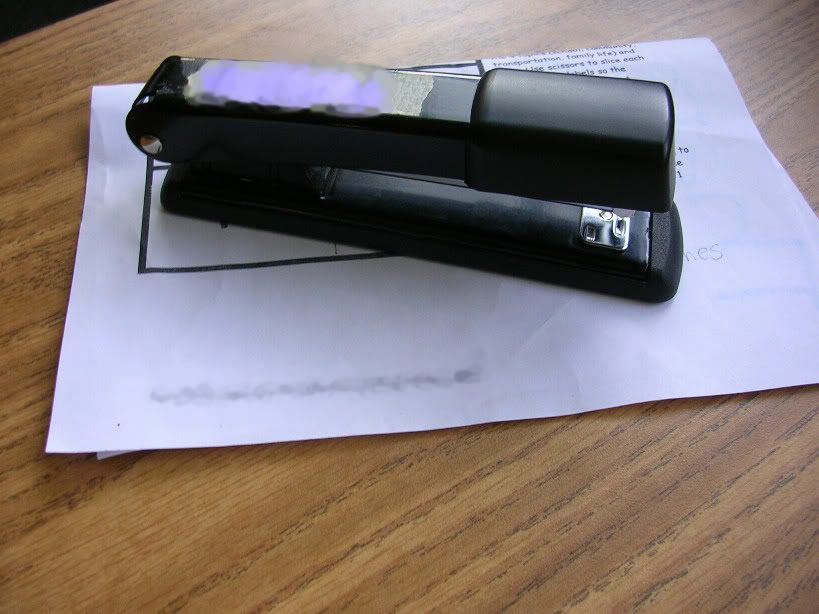
When I came back to my classroom today, this was on my desk...

This was the note inside the paper...

As soon as I opened it, I nodded, going immediately to get some staples with which to reload our stapler. On my way, I stopped and giggled to myself, because it hit me what words were actually on the note. I'll let you reread...
I realized that someone that doesn't work with or think like young children on a regular basis might find the whole thing odd. There is not stapler -- in a note... underneath a stapler. Hahahaha!! Logically, well, it doesn't make sense. Why wonder about the stapler when it's right there? It amused me greatly, I think, because sometimes I get so used to reading/interpreting the meaning behind what my students are saying or writing, that I forget that sometimes the literal translations are priceless.
First grade is awesome. ♥
Also, we had our First Grade family night tonight -- nearly all of the first graders showed up and we taught our families about the famous Americans that we have to study this year. The kids were amazing! Tomorrow we're having a popcorn & lemonade party to celebrate. But, shhhhh... they don't know it yet.
*love*
When I came back to my classroom today, this was on my desk...
This was the note inside the paper...

As soon as I opened it, I nodded, going immediately to get some staples with which to reload our stapler. On my way, I stopped and giggled to myself, because it hit me what words were actually on the note. I'll let you reread...
I realized that someone that doesn't work with or think like young children on a regular basis might find the whole thing odd. There is not stapler -- in a note... underneath a stapler. Hahahaha!! Logically, well, it doesn't make sense. Why wonder about the stapler when it's right there? It amused me greatly, I think, because sometimes I get so used to reading/interpreting the meaning behind what my students are saying or writing, that I forget that sometimes the literal translations are priceless.
First grade is awesome. ♥
Also, we had our First Grade family night tonight -- nearly all of the first graders showed up and we taught our families about the famous Americans that we have to study this year. The kids were amazing! Tomorrow we're having a popcorn & lemonade party to celebrate. But, shhhhh... they don't know it yet.
*love*
Tuesday, April 22, 2008
awesome is... walking down the hallway with leis
There might be nothing more awesome in the world than buying a tonne of (fake) leis in Hawai'i, bringing them back home, greeting every student in my class with an Aloha! and a lei draped over their neck, then watching them all walk lei-adorned down to the lunch room with big grins on their faces.
Even better when six of them wear their leis to school today, just because they love them so much. ♥ I might still be wearing mine, but I'll never tell.
Even better when six of them wear their leis to school today, just because they love them so much. ♥ I might still be wearing mine, but I'll never tell.
Friday, April 11, 2008
kindness...
"Hello, babies. Welcome to Earth. It's hot in the summer and cold in the winter. It's round and wet and crowded. At the outside, babies, you've got about a hundred years here. There's only one rule that I know of, babies -- 'Goddamn it, you've got to be kind.'"
-- Kurt Vonnegut, "God Bless You, Mr. Rosewater"
Sadly, I've not yet read this book, though I've read at least two others by Mr. Vonnegut. It's interesting to me how I've held onto that quotation for years now. I read it at some point in college; it was probably on a poster or t-shirt or other inspirational wearable/hangable they sell in college bookstores.
I dutifully wrote it down in the quote book that my boyfriend and I used to pass back and forth, sighing and whispering at each other in the tone you can only use in those long distance college relationships when you've still got to wait another thirty-four days before you see each other again and so you [censored for my mother's eyes] on the phone to each other, and this is the height of intimacy.
The boyfriend, the quotebook, and the desire to do naughty things over the phone are long gone, but the quote remains. It's a bit tattered actually; it took me a while to find it because I'd misremembered some of the language and I didn't know the original source.
When Kurt Vonnegut died a year ago today, I really got thinking deeply about this quote.
Particularly in the world the way I see it sometimes nowadays, both in the rush of in person and the craziness of the internet and the lure of reality TV, it struck me recently that kindness doesn't present itself in current culture to be much of a virtue. Insults, sarcasm, pointing or sharing blame come up so frequently in what I see.
And yet, what do I remember?
I remember a teacher that I didn't know very well see me burst into tears in the hallway after saying good bye to a student that was moving away. She came over immediately and hugged me. We didn't know each other very well -- let alone well enough to hug each other -- but she did.
I remember a woman I'd never seen or met before in my life offer to buy my entire first grade class an $18 bag of peaches that they were dying to eat, just because she was so impressed with the way they handled themselves in the store.
I remember watching one of my students give up the chance for a coveted job in the classroom just to help another student feel a little bit better on a morning when he could have fallen apart.
I remember so many of you. So many little, tiny infusions of kindness that fill the spaces inside me and seep out as reminders when I'm feeling distraught.
Always, always, I remember kindness.
The word "kindness" in my mind is almost inextricably linked to Vonnegut's quote, so I think of it on a pretty regular basis.
I have thirty-some years in this job. At roughly twenty students per year, I figure I've got 600 students to connect with and 180 days with which to do it.
And if I can't help to infuse the very essence of why it's important to be kind... well, then I really shouldn't be doing this.
-- Kurt Vonnegut, "God Bless You, Mr. Rosewater"
Sadly, I've not yet read this book, though I've read at least two others by Mr. Vonnegut. It's interesting to me how I've held onto that quotation for years now. I read it at some point in college; it was probably on a poster or t-shirt or other inspirational wearable/hangable they sell in college bookstores.
I dutifully wrote it down in the quote book that my boyfriend and I used to pass back and forth, sighing and whispering at each other in the tone you can only use in those long distance college relationships when you've still got to wait another thirty-four days before you see each other again and so you [censored for my mother's eyes] on the phone to each other, and this is the height of intimacy.
The boyfriend, the quotebook, and the desire to do naughty things over the phone are long gone, but the quote remains. It's a bit tattered actually; it took me a while to find it because I'd misremembered some of the language and I didn't know the original source.
When Kurt Vonnegut died a year ago today, I really got thinking deeply about this quote.
Particularly in the world the way I see it sometimes nowadays, both in the rush of in person and the craziness of the internet and the lure of reality TV, it struck me recently that kindness doesn't present itself in current culture to be much of a virtue. Insults, sarcasm, pointing or sharing blame come up so frequently in what I see.
And yet, what do I remember?
I remember a teacher that I didn't know very well see me burst into tears in the hallway after saying good bye to a student that was moving away. She came over immediately and hugged me. We didn't know each other very well -- let alone well enough to hug each other -- but she did.
I remember a woman I'd never seen or met before in my life offer to buy my entire first grade class an $18 bag of peaches that they were dying to eat, just because she was so impressed with the way they handled themselves in the store.
I remember watching one of my students give up the chance for a coveted job in the classroom just to help another student feel a little bit better on a morning when he could have fallen apart.
I remember so many of you. So many little, tiny infusions of kindness that fill the spaces inside me and seep out as reminders when I'm feeling distraught.
Always, always, I remember kindness.
The word "kindness" in my mind is almost inextricably linked to Vonnegut's quote, so I think of it on a pretty regular basis.
I have thirty-some years in this job. At roughly twenty students per year, I figure I've got 600 students to connect with and 180 days with which to do it.
And if I can't help to infuse the very essence of why it's important to be kind... well, then I really shouldn't be doing this.
Thursday, April 10, 2008
I went to Walmart with my mother...
It really amazes me, sometimes, the way children write. Or can write, if given the chance to be inspired.
And time.
What I've noticed over my years of teaching is that First Graders are prone to writing stories like this: I went to Walmart. I got a game. I went home. The end.
With practice and support, they start adding details... not always interesting details, but details. Like: "I went to Walmart with my mom...
Six year olds tend to think in a forward linear path with lots of "ands" that start when they wake up and end when they go to bed. A day is an important, large -- but finite -- period of time, and their writing shows this.
So, for a couple of years now, I've always enjoyed Writing Workshop, but I've also felt like there was something that I wasn't quite doing to push them further, to really support them in developing more deeply as writers.
About two months ago, through a short class I took, I read a book that I just may buy 400 copies of, just to give to my closest friends: About the Authors.
One of the biggest "a-ha" moments for me in reading this book was learning the way they recommend using children's literature as "mentor texts," the way they explore, with the children, the way different writers choose to write something (looking at one page or one passage) or a style choice (using ellipses or repeating a certain phrase) or something as simple as writing LARGE words for something that is said loudly.
I thought, Of course! I do that, myself, as a writer. I notice the way other writers write and I think about that sometimes when I'm writing. Why wouldn't that be the same for children?
Often, I sit down with the basket of my students' writing folders and read what's in there: what they have in progress, what they're working on. I notice some of their mechanics, make notes about what to talk to them about, but I also just read to get an overall feel for my class as a group of writers. I do this because, no matter how much time we have for Writing Workshop, I rarely sit down with more than four students, so there is a lot of writing they do that I miss.
In the past, this process has always been good. But, again, their stories tended to follow a similar pattern to what I mentioned above, sometimes with interesting word use. Or dialogue. But not generally things that really stood out to me.
My friends, over the past several weeks, sitting down with their writing has been amazing. Yes, there is still a lot of "I went to Walmart with my mother..." but probably 40% of it isn't like that. I have been genuinely surprised and pleased by what is coming out of my students these days -- and not the same few students over and over. Every single one of them has written something recently that really captures their voice. They're writing stories about themselves, but also writing their own versions of folk tales that we've read together, writing informational books, writing something to teach someone else.
I'd like to share two small pieces with you...
This first piece was written today. It's still a work in progess. When I sat down with Ryan today, he looked pained. He said, "Ms. F, I want to write about my dream, but I don't want to think about it. It was a bad dream."
I thought for a minute and said, "Could you write that?"
"That I don't want to think about it?"
"Yeah. Do you think anyone else has ever felt that way?"
He was quiet. "Probably, yeah. I know other kids have bad dreams sometimes."
"So then, if you wrote that, a lot of readers might connect with that, they'd understand what you meant."
"Yeah." Then he said, "Do you think that would help me talk about my dream?"
I said, "Well, if you start with what you've told me, maybe see how you feel as you're writing. Sometimes once you get started you figure out what you want to say."
"Alright."
I touched his nose and he grinned at me.
"I'll come check on you later then, yeah?"
"Yeah."
Okay, so this is the title and the first two pages...


[I don't want to think about my bad dream.]

[I don't want to tell you because it was scary.]
Tell me that isn't a powerful start to a piece of writing. ♥
This next piece is from Alejandro. His brain is amazing. I'm forever talking about him with other teachers and he is constantly on my mind because of the sheer depth of how he thinks about things. This boy is a freakin' philosopher. In sneakers.
So, Alejandro has regularly incorporated interesting elements into his writing. In fact, he's famous in our class for using: Aaaaaaaaaaaaaaaaaahhh!! to describe the sound of someone yelling as they rode a roller coaster. In bold print.
This is what I found in his writing folder today (from a piece he wrote last week):

[I went to my cousin's house.]


[We ordered a pizza.]


[I said in my brain...]

[It is the best day ever.]
Seriously. What voice! And the details in his illustrations -- did you catch the "hot" word on the pizza box? And the fact that the final page is a drawing of his brain, showing what he was thinking in that little thought bubble?
The thing that was the most telling in my read-through of my students' writing today was this: they're really not amazing with punctuation yet (remembering periods instead of just using "and", etc...) but every single one of them knows how to use elllipses. Well.
First graders are amazing.
And time.
What I've noticed over my years of teaching is that First Graders are prone to writing stories like this: I went to Walmart. I got a game. I went home. The end.
With practice and support, they start adding details... not always interesting details, but details. Like: "I went to Walmart with my mom...
Six year olds tend to think in a forward linear path with lots of "ands" that start when they wake up and end when they go to bed. A day is an important, large -- but finite -- period of time, and their writing shows this.
So, for a couple of years now, I've always enjoyed Writing Workshop, but I've also felt like there was something that I wasn't quite doing to push them further, to really support them in developing more deeply as writers.
About two months ago, through a short class I took, I read a book that I just may buy 400 copies of, just to give to my closest friends: About the Authors.
One of the biggest "a-ha" moments for me in reading this book was learning the way they recommend using children's literature as "mentor texts," the way they explore, with the children, the way different writers choose to write something (looking at one page or one passage) or a style choice (using ellipses or repeating a certain phrase) or something as simple as writing LARGE words for something that is said loudly.
I thought, Of course! I do that, myself, as a writer. I notice the way other writers write and I think about that sometimes when I'm writing. Why wouldn't that be the same for children?
Often, I sit down with the basket of my students' writing folders and read what's in there: what they have in progress, what they're working on. I notice some of their mechanics, make notes about what to talk to them about, but I also just read to get an overall feel for my class as a group of writers. I do this because, no matter how much time we have for Writing Workshop, I rarely sit down with more than four students, so there is a lot of writing they do that I miss.
In the past, this process has always been good. But, again, their stories tended to follow a similar pattern to what I mentioned above, sometimes with interesting word use. Or dialogue. But not generally things that really stood out to me.
My friends, over the past several weeks, sitting down with their writing has been amazing. Yes, there is still a lot of "I went to Walmart with my mother..." but probably 40% of it isn't like that. I have been genuinely surprised and pleased by what is coming out of my students these days -- and not the same few students over and over. Every single one of them has written something recently that really captures their voice. They're writing stories about themselves, but also writing their own versions of folk tales that we've read together, writing informational books, writing something to teach someone else.
I'd like to share two small pieces with you...
This first piece was written today. It's still a work in progess. When I sat down with Ryan today, he looked pained. He said, "Ms. F, I want to write about my dream, but I don't want to think about it. It was a bad dream."
I thought for a minute and said, "Could you write that?"
"That I don't want to think about it?"
"Yeah. Do you think anyone else has ever felt that way?"
He was quiet. "Probably, yeah. I know other kids have bad dreams sometimes."
"So then, if you wrote that, a lot of readers might connect with that, they'd understand what you meant."
"Yeah." Then he said, "Do you think that would help me talk about my dream?"
I said, "Well, if you start with what you've told me, maybe see how you feel as you're writing. Sometimes once you get started you figure out what you want to say."
"Alright."
I touched his nose and he grinned at me.
"I'll come check on you later then, yeah?"
"Yeah."
Okay, so this is the title and the first two pages...
[I don't want to think about my bad dream.]
[I don't want to tell you because it was scary.]
Tell me that isn't a powerful start to a piece of writing. ♥
This next piece is from Alejandro. His brain is amazing. I'm forever talking about him with other teachers and he is constantly on my mind because of the sheer depth of how he thinks about things. This boy is a freakin' philosopher. In sneakers.
So, Alejandro has regularly incorporated interesting elements into his writing. In fact, he's famous in our class for using: Aaaaaaaaaaaaaaaaaahhh!! to describe the sound of someone yelling as they rode a roller coaster. In bold print.
This is what I found in his writing folder today (from a piece he wrote last week):
[I went to my cousin's house.]
[We ordered a pizza.]
[I said in my brain...]
[It is the best day ever.]
Seriously. What voice! And the details in his illustrations -- did you catch the "hot" word on the pizza box? And the fact that the final page is a drawing of his brain, showing what he was thinking in that little thought bubble?
The thing that was the most telling in my read-through of my students' writing today was this: they're really not amazing with punctuation yet (remembering periods instead of just using "and", etc...) but every single one of them knows how to use elllipses. Well.
First graders are amazing.
Thursday, April 3, 2008
slightly imperfect, as is
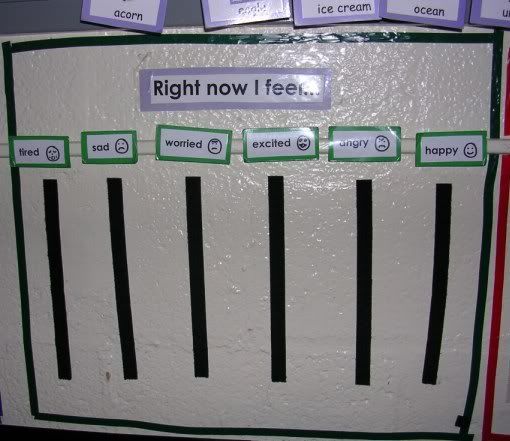
In my classroom I have a feeling board. It looks like this.
It serves many purposes for my First Graders. It allows them to recognize and name feelings (some, for the very first time), to see that one can feel a strong emotion and still manage self-control, to notice that feelings can, and do, change -- sometimes within moments.
It is an imperfect system, at best. Space allows for only six feelings listed with no crossover. But feelings don't come that way. They're multi-layered, confusing, and sometimes defy simple definition. I know this. We talk about it in the classroom. We discuss how it doesn't always quite work, about the need to change our card during the day, about talking with others, about taking down the feeling board altogether (goodness knows we could use the wall space!). Interestingly -- or perhaps, importantly -- enough, no class of mine has ever wanted to get rid of it. We have made changes, we've added and removed things, written books to supplement this need, but have never taken it down.
Ultimately, though, it is a flawed system. No matter how we may want it, emotions don't fit themselves into neat, handy little packages.
This has been on my mind, more frequently than normal, all week long.
A friend of mine, a dear friend that I have never seen in person, never touched or hugged or bumped her shoulder with glee, was killed in a car accident on Sunday.
So far this week I've been through denial, anger, acceptance, sadness, frustration, gratitude, disbelief, and about three other emotions that I don't think have been invented yet. With each one, I keep expecting it to be the last, that I will somehow choose this feeling and it will be the one that sticks, so then I can move on.
Except it persists in Not Working That Way.
Then I walk into my classroom in the morning, find the feeling board with my eyes and wonder (again) why what I've learned and discussed and known through twelve years of teaching doesn't somehow penetrate my own adult consciousness. Why is it that I know and understand the sheer magnitude of emotion for every single one of my six year olds and can't seem to find it for myself?
I keep saying: I'll get there. I will. But, where, exactly, am I trying to get? What am I trying to achieve? I don't want to forget Anj. I'm not going to disregard or push aside the joy of being her friend, of what I've learned from her, what I've admired and loved and aspired to. I'm not going to overlook how she loved me, how she somehow found inspiration from stories of my own, how we connected, over and over, through our sheer faith in the power of children.
I miss her. I know that. And maybe if I keep telling myself that I don't actually need to find some 'answer', maybe at some point I'll believe it.
I don't know the answer, but then... I'm not sure I know the question either.
♥ to all of you. You are truly a blessing. Please know that.
It serves many purposes for my First Graders. It allows them to recognize and name feelings (some, for the very first time), to see that one can feel a strong emotion and still manage self-control, to notice that feelings can, and do, change -- sometimes within moments.
It is an imperfect system, at best. Space allows for only six feelings listed with no crossover. But feelings don't come that way. They're multi-layered, confusing, and sometimes defy simple definition. I know this. We talk about it in the classroom. We discuss how it doesn't always quite work, about the need to change our card during the day, about talking with others, about taking down the feeling board altogether (goodness knows we could use the wall space!). Interestingly -- or perhaps, importantly -- enough, no class of mine has ever wanted to get rid of it. We have made changes, we've added and removed things, written books to supplement this need, but have never taken it down.
Ultimately, though, it is a flawed system. No matter how we may want it, emotions don't fit themselves into neat, handy little packages.
This has been on my mind, more frequently than normal, all week long.
A friend of mine, a dear friend that I have never seen in person, never touched or hugged or bumped her shoulder with glee, was killed in a car accident on Sunday.
So far this week I've been through denial, anger, acceptance, sadness, frustration, gratitude, disbelief, and about three other emotions that I don't think have been invented yet. With each one, I keep expecting it to be the last, that I will somehow choose this feeling and it will be the one that sticks, so then I can move on.
Except it persists in Not Working That Way.
Then I walk into my classroom in the morning, find the feeling board with my eyes and wonder (again) why what I've learned and discussed and known through twelve years of teaching doesn't somehow penetrate my own adult consciousness. Why is it that I know and understand the sheer magnitude of emotion for every single one of my six year olds and can't seem to find it for myself?
I keep saying: I'll get there. I will. But, where, exactly, am I trying to get? What am I trying to achieve? I don't want to forget Anj. I'm not going to disregard or push aside the joy of being her friend, of what I've learned from her, what I've admired and loved and aspired to. I'm not going to overlook how she loved me, how she somehow found inspiration from stories of my own, how we connected, over and over, through our sheer faith in the power of children.
I miss her. I know that. And maybe if I keep telling myself that I don't actually need to find some 'answer', maybe at some point I'll believe it.
I don't know the answer, but then... I'm not sure I know the question either.
♥ to all of you. You are truly a blessing. Please know that.
Saturday, March 8, 2008
by miz f, aged 34
Lina and I were previewing a book before she was going to read it to me. I'd drawn a picture of a mouse and wrote 'mouse' then drew a picture of three mice and wrote 'mice.' She pointed to the first one and this conversation ensued:
Lina: Well, so that's the mouse, and those are the mouse-lings.
me: The what?
Lina: The mouse-lings.
me: *light begins to dawn* What are mouse-lings?
Lina: *gives me the grand pitying look of, 'oh you stupid grown-up'* You know, like the mother duck and the little ducklings. Those are the little mouse-lings.
me: Baby mice.
Lina: Yes.
me: That's a really insightful idea about what to call them.
Lina: Yeah?
me: Yeah. Only sadly, they're just called baby mice. Which is really too bad, because 'mouse-lings' might be my new favorite word.
Lina: *grins at me*
me: *grins back*
Lina: We should tell the class.
me: We totally should.
We did.
Sunday, January 27, 2008
thoughts on community...
A few days ago, I wrote about one of my students and the letter she wrote me that made me slow down. As teachers, we're often moving at breakneck pace, trying to keep up with standards, benchmarks, stay true to the kids in our classes, be responsive to the kids and the school and the report card expectations, to remember Stay off of Drugs week and everything that comes across in single days of teaching.
It's exhausting.
Yet, every lesson I've learned from teaching has taught me the value of slowing down. Not slowing down my expectations or the work we're doing, but slowing myself down. Watching the children and being responsive to them, which, in turn, teaches them to be responsive to each other. Breathing. Sometimes breathing twice before saying anything.
This weekend, the lesson I learned from my student's letter has been at the very forefront in my mind. I have been moving at breakneck pace, getting report cards done, trying to keep up with our pacing guide, trying to balance this work with all of the responsibilities in my non-work life.
So, Kamaya's letter to me just helped me put my breaks on completely, in a very needed way.
I said in my post: They get it. They know.
Every time I've had doubt about the value of slowing down, of taking the time to build and maintain the culture of our own classroom community, the children have always reminded me.
It is worth it.
I wish I could tell you Kamaya's real name. I wish I could show you a picture of her, so you could hold an image of her in your mind while you read the letter that guided me toward that needed epiphany on Friday. But, her privacy is far more important, so I can't show you her picture, but you can get an idea of her spirit. Of the beauty and love that she exudes, even when she's not trying.
My friends, they all do that.
They know, sometimes even more than I do, that our classroom is something extraordinary. They know that not everything in life works the way our community does. It works because we care about making it work. And it's not just me, as the teacher. It's all of us.
Here's another story:
In October, my students were taking a Math assessment that spanned two days and about 40-55 minutes each day. It was very unlike anything they've done before: putting up folders so it can be individual work, not talking and collaborating. This Math assessment is one that our school system is trying to develop, so my school is piloting it so we can give feedback about what's good and what needs to be changed.
In spite of my assurances to my class that they should just do their best and not worry about something if they didn't know the answer, they did worry. It stressed some of them out, which just tightens little iron rings around my heart, because I hate watching them stress about something that means (IMO) relatively little.
So, on the second day, I had a little brainstorm of something to do before we began the 2nd part of the assessment. I reminded them again that it was not something they should worry about -- it was just something that would tell me what they already knew and what I still needed to teach them. I also said that sometimes, when people have to do something that they're nervous about, it helps to have something new or fun to hold onto.
I showed them a bunch of brand new, fancy pencils that I'd sharpened and told them that everyone would get to choose a brand new pencil to use for the assessment and then they could keep it afterward.
The kids were so excited, and Ghaazi said, "You're the best teacher ever!"
I'm not arrogant enough to believe that whenever a child says that to me, because, really, it's often an expression they use to let me know that they are just really, really happy right then. I smiled at him and he turned around and pointed to our Rules, number 2, and he said,
"You're being nice to others!"
"I am, yes," I said. "Can I ask something about it?"
They all nodded at me.
"So, you might be feeling nervous about this Math work we're going to do." Several of them nodded. "And you're excited about having a brand new pencil to work with and then keep?" They all nodded. "I know that that is 'being nice to others' -- like our Rule 2." More nods.
"And while it makes me feel proud if someone says, 'you're the best teacher' -- I want to ask you guys something. Look at our list of rules." They did. "Who made those rules?"
"We did," they said.
"Yeah. I helped guide us and asked a lot of questions and did the writing. But we all shared our Hopes and Goals for first grade, and we all talked about rules we would need to help us achieve them, and we all wrote the rules together..."
Again, they nodded, and some of them were starting to smile a little bit.
"So, when I do something that is being nice to others, I'm following our rules. I didn't tell you what the rules would be."
"Right, we made them!" Ghaazi said.
"So, Ghaazi, I wonder about what you said before -- I don't think it's just--"
"Yeah," he said, getting all excited, "I just love it here!"
"And that's not just me, is it?" I said. "I'm not the only one here!"
"No, it's all of us!" Britney said.
"We all do these things!"
"It's our commoodity!" Lina said. [community! ♥]
Which it is. I had to wait until after school to really let myself dissolve into the proud, overwhelming tears that I felt after that conversation, because they really do get it. They get the feeling of trying to understand everyone else, of caring about everyone even if they're not your best friend, because everyone adds something to our community. They feel how good it is to be doing this work together.
They know.
It humbles me to be a part of this process, because I learn more from them then I do from almost anything else in my life. It's because of my students that I know how to step back and not get involved in arguments or wank or general orneriness in other parts of life. It's because of them that I can help myself find the positive when things feel overwhelming and hard.
Now that I've realized this once again; now that I've made some changes in some of the learning we're going to be doing next week (starting a new focus in both writing and math that are going to just jazz them up completely!!), I can't wait to get started.
While I'm always grateful for professional development and I'm excited about an Inservice that I'm attending tomorrow, I want to be in the classroom tomorrow. I want to get started on all this new learning.
I miss my commoodity. ♥
It's exhausting.
Yet, every lesson I've learned from teaching has taught me the value of slowing down. Not slowing down my expectations or the work we're doing, but slowing myself down. Watching the children and being responsive to them, which, in turn, teaches them to be responsive to each other. Breathing. Sometimes breathing twice before saying anything.
This weekend, the lesson I learned from my student's letter has been at the very forefront in my mind. I have been moving at breakneck pace, getting report cards done, trying to keep up with our pacing guide, trying to balance this work with all of the responsibilities in my non-work life.
So, Kamaya's letter to me just helped me put my breaks on completely, in a very needed way.
I said in my post: They get it. They know.
Every time I've had doubt about the value of slowing down, of taking the time to build and maintain the culture of our own classroom community, the children have always reminded me.
It is worth it.
I wish I could tell you Kamaya's real name. I wish I could show you a picture of her, so you could hold an image of her in your mind while you read the letter that guided me toward that needed epiphany on Friday. But, her privacy is far more important, so I can't show you her picture, but you can get an idea of her spirit. Of the beauty and love that she exudes, even when she's not trying.
My friends, they all do that.
They know, sometimes even more than I do, that our classroom is something extraordinary. They know that not everything in life works the way our community does. It works because we care about making it work. And it's not just me, as the teacher. It's all of us.
Here's another story:
In October, my students were taking a Math assessment that spanned two days and about 40-55 minutes each day. It was very unlike anything they've done before: putting up folders so it can be individual work, not talking and collaborating. This Math assessment is one that our school system is trying to develop, so my school is piloting it so we can give feedback about what's good and what needs to be changed.
In spite of my assurances to my class that they should just do their best and not worry about something if they didn't know the answer, they did worry. It stressed some of them out, which just tightens little iron rings around my heart, because I hate watching them stress about something that means (IMO) relatively little.
So, on the second day, I had a little brainstorm of something to do before we began the 2nd part of the assessment. I reminded them again that it was not something they should worry about -- it was just something that would tell me what they already knew and what I still needed to teach them. I also said that sometimes, when people have to do something that they're nervous about, it helps to have something new or fun to hold onto.
I showed them a bunch of brand new, fancy pencils that I'd sharpened and told them that everyone would get to choose a brand new pencil to use for the assessment and then they could keep it afterward.
The kids were so excited, and Ghaazi said, "You're the best teacher ever!"
I'm not arrogant enough to believe that whenever a child says that to me, because, really, it's often an expression they use to let me know that they are just really, really happy right then. I smiled at him and he turned around and pointed to our Rules, number 2, and he said,
"You're being nice to others!"
"I am, yes," I said. "Can I ask something about it?"
They all nodded at me.
"So, you might be feeling nervous about this Math work we're going to do." Several of them nodded. "And you're excited about having a brand new pencil to work with and then keep?" They all nodded. "I know that that is 'being nice to others' -- like our Rule 2." More nods.
"And while it makes me feel proud if someone says, 'you're the best teacher' -- I want to ask you guys something. Look at our list of rules." They did. "Who made those rules?"
"We did," they said.
"Yeah. I helped guide us and asked a lot of questions and did the writing. But we all shared our Hopes and Goals for first grade, and we all talked about rules we would need to help us achieve them, and we all wrote the rules together..."
Again, they nodded, and some of them were starting to smile a little bit.
"So, when I do something that is being nice to others, I'm following our rules. I didn't tell you what the rules would be."
"Right, we made them!" Ghaazi said.
"So, Ghaazi, I wonder about what you said before -- I don't think it's just--"
"Yeah," he said, getting all excited, "I just love it here!"
"And that's not just me, is it?" I said. "I'm not the only one here!"
"No, it's all of us!" Britney said.
"We all do these things!"
"It's our commoodity!" Lina said. [community! ♥]
Which it is. I had to wait until after school to really let myself dissolve into the proud, overwhelming tears that I felt after that conversation, because they really do get it. They get the feeling of trying to understand everyone else, of caring about everyone even if they're not your best friend, because everyone adds something to our community. They feel how good it is to be doing this work together.
They know.
It humbles me to be a part of this process, because I learn more from them then I do from almost anything else in my life. It's because of my students that I know how to step back and not get involved in arguments or wank or general orneriness in other parts of life. It's because of them that I can help myself find the positive when things feel overwhelming and hard.
Now that I've realized this once again; now that I've made some changes in some of the learning we're going to be doing next week (starting a new focus in both writing and math that are going to just jazz them up completely!!), I can't wait to get started.
While I'm always grateful for professional development and I'm excited about an Inservice that I'm attending tomorrow, I want to be in the classroom tomorrow. I want to get started on all this new learning.
I miss my commoodity. ♥
Friday, January 25, 2008
Children do pay attention...
I often find that January is a strange time for teaching and learning. It's a bit lethargic, a lot cold, and full of a lot of sameness. During this time, I always have to find ways to reinvigorate myself, and in turn, the children. If I do, it's a very cyclical process, and one that benefits me just as much as it does the children.
Well.
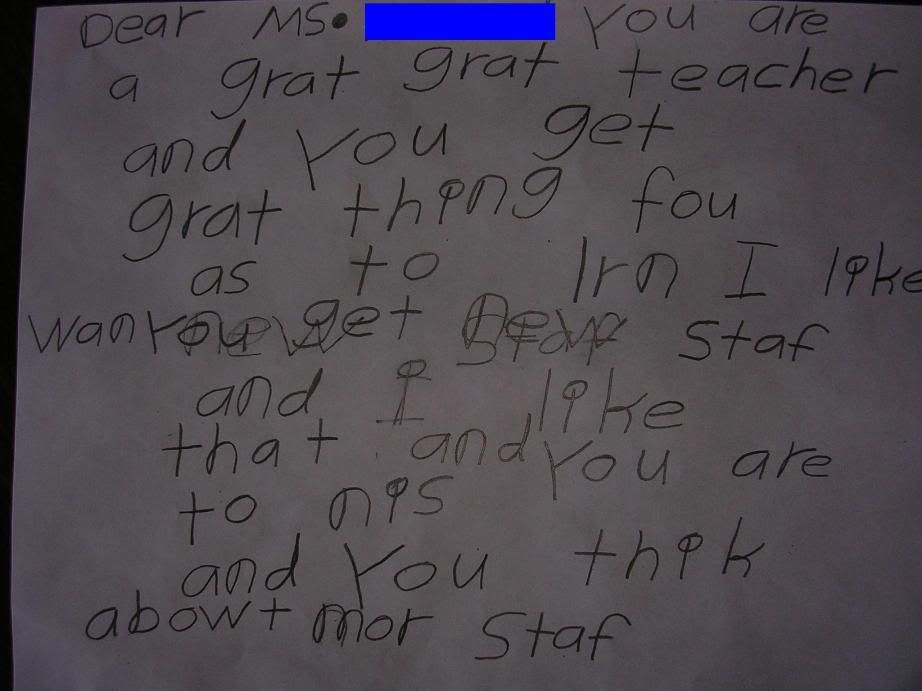
A few minutes ago, I was cleaning out some files and rediscovered this letter that one of my students wrote to me in early November.

[click to make the picture larger]
TEXT: Dear Ms. [me] you are
a great great teacher
and you get
great things for
us to learn. I like
when you get new stuff
and I like
that. And you are
too nice
and you think
about more stuff

[click to make the picture larger]
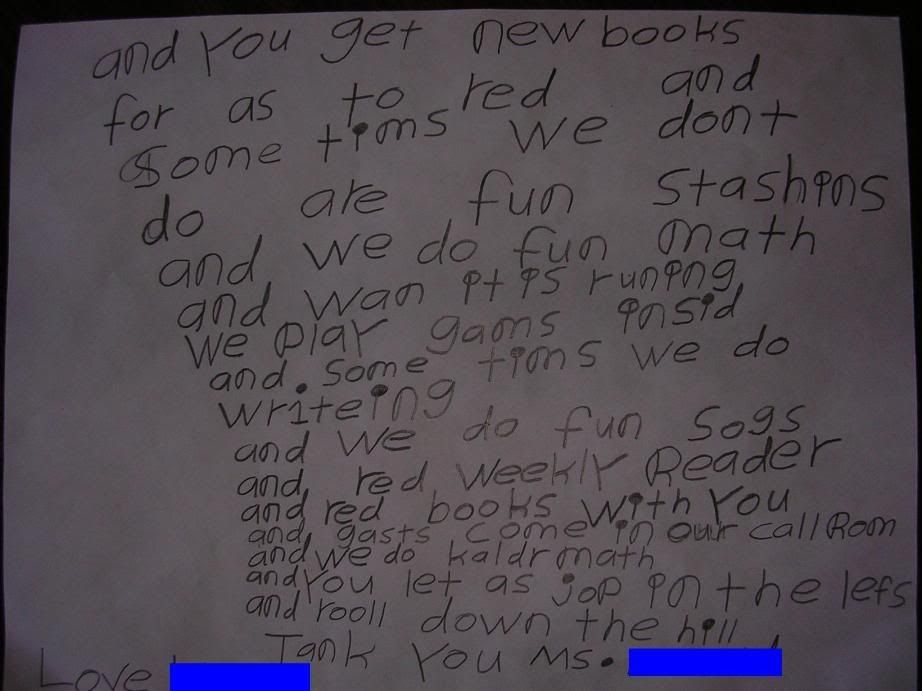
TEXT: and you get new books
for us to read and
some times we don't
do our fun stations
and we do fun math.
and when it is raining
we play games inside
and sometimes we do
writing
and we do fun songs
and read Weekly Reader
and read books with you
and guests come in our cool room
and we do calendar math
and you let us jump in the leaves
and roll down the hill
thank you Ms. [me]
love, [her]
Sometimes I think we, as adults, forget about the incredibly intense and deep observation skills of children. If I ever doubt it again, I just need to look at this letter again to be reminded.
They get it. They know.
Well.
A few minutes ago, I was cleaning out some files and rediscovered this letter that one of my students wrote to me in early November.
[click to make the picture larger]
TEXT: Dear Ms. [me] you are
a great great teacher
and you get
great things for
us to learn. I like
when you get new stuff
and I like
that. And you are
too nice
and you think
about more stuff
[click to make the picture larger]
TEXT: and you get new books
for us to read and
some times we don't
do our fun stations
and we do fun math.
and when it is raining
we play games inside
and sometimes we do
writing
and we do fun songs
and read Weekly Reader
and read books with you
and guests come in our cool room
and we do calendar math
and you let us jump in the leaves
and roll down the hill
thank you Ms. [me]
love, [her]
Sometimes I think we, as adults, forget about the incredibly intense and deep observation skills of children. If I ever doubt it again, I just need to look at this letter again to be reminded.
They get it. They know.
Wednesday, November 21, 2007
Creating language [the Alejandro train, part 2]
One of the things that amazes me about children is how much they want language. They like to know words. They like learning words. They like naming things. They like naming things so much that they do it wrong alot, they generalize and make connections or associations that we as adults see as incorrect, but are generally quite intelligent in their path.
The other thing that I've noticed, that has been driven home to me again and again this year, is that if children don't have the language they need to describe something, they will make it up themselves.
In first grade, we've been focusing on Geometry. A lot. We've found shapes, we've touched them, we've played with them until our minds are so steeped with triangles that we see them everywhere!
And, yet, six year olds don't typically don't have the words that we all find later in life: equilateral, isosceles, acute, hypotenuse. Yet, they are holding in their hand actual examples of each of these things, and they need to find words to describe them. It's fascinating to watch.
Alejandro described (an equilateral) triangle to our class not too long ago. He touched each side and said:
"It goes: corner, slide side, corner, slide side, corner, slide side. Then that's the end."
Several of the students nodded, several just looked at him, and six more were already raising their hands to share their own ideas about a triangle.
I didn't pay too much attention to Alejandro's definition at the time; I had also nodded at him (encouragingly, of course), but I hadn't understood what he meant and didn't take the time to probe further. I should have.
Well, Majid did that for me instead.
The next day, Majid was using our Power Polygons and touching each of them, paying particular interest to the triangles. I went and sat down next to him, just watching what he was doing. At the time, he had an isosceles and a right triangle in front of him.
"Are those the same?" I asked.
"They're a little the same," he said. "But they're also different."
"How are they different?"
He took the isosceles triangle and said, "This one goes: slide side, slide side, slide side." Then he picked up the right triangle. "But this one goes slide side, straight side, then straight side again."
The straight sides he talked about were the two sides that formed the right angle.
"Why are those 'straight sides'?" I asked.
"Well," he said without hesitation, "see that part?" He pointed to the right angle. "It's different than the other parts because it makes the sides straight."
During this time, I noticed that he used the word straight to describe something and wondered if he also knew the difference between curved and straight (ie, was he choosing the word "straight" because he didn't have another word to use it -- or was straight v. curved something he didn't know yet). I made a note to ask about the curved vs. straight thing later, but didn't want to interrupt the flow of the conversation.
"So this corner," I said, pointing to the right angle, "is different than the other corners?"
"Yeah."
"It does have a special name, actually, do you want to know it?"
He nodded vigorously.
"It's a right angle, or a square corner."
"Oooh!" he said. "Square like a square!"
"That's right. Can you find a square?"
He did.
"Put the square on top of the triangle and match up the corners."
He did and noticed that the right angle of the triangle was the same corner that was on the square.
Then Majid started looking for other right triangles and matching them up with the square. He tried other triangles, but realized that the angles didn't match up.
So, the thing that struck me -- apart from just the brilliance that children can have when they're allowed to just mess about with something -- is that Majid understood Alejandro's use of "slide side" from days before, then made his own interpretation of it and put his own name onto another kind of side on the triangle -- the "straight" side.
Now, other students haven't messed about enough with the shapes to be able to really see and describe the difference between the other triangles, but Majid not only saw it, he wanted to name it. He took the language that someone else had given him, and then added his own. What I see is our class developing our own vernacular to describe what we're learning. It's such an interestingly organic process to be a part of.
I have an amazing job.
The other thing that I've noticed, that has been driven home to me again and again this year, is that if children don't have the language they need to describe something, they will make it up themselves.
In first grade, we've been focusing on Geometry. A lot. We've found shapes, we've touched them, we've played with them until our minds are so steeped with triangles that we see them everywhere!
And, yet, six year olds don't typically don't have the words that we all find later in life: equilateral, isosceles, acute, hypotenuse. Yet, they are holding in their hand actual examples of each of these things, and they need to find words to describe them. It's fascinating to watch.
Alejandro described (an equilateral) triangle to our class not too long ago. He touched each side and said:
"It goes: corner, slide side, corner, slide side, corner, slide side. Then that's the end."
Several of the students nodded, several just looked at him, and six more were already raising their hands to share their own ideas about a triangle.
I didn't pay too much attention to Alejandro's definition at the time; I had also nodded at him (encouragingly, of course), but I hadn't understood what he meant and didn't take the time to probe further. I should have.
Well, Majid did that for me instead.
The next day, Majid was using our Power Polygons and touching each of them, paying particular interest to the triangles. I went and sat down next to him, just watching what he was doing. At the time, he had an isosceles and a right triangle in front of him.
"Are those the same?" I asked.
"They're a little the same," he said. "But they're also different."
"How are they different?"
He took the isosceles triangle and said, "This one goes: slide side, slide side, slide side." Then he picked up the right triangle. "But this one goes slide side, straight side, then straight side again."
The straight sides he talked about were the two sides that formed the right angle.
"Why are those 'straight sides'?" I asked.
"Well," he said without hesitation, "see that part?" He pointed to the right angle. "It's different than the other parts because it makes the sides straight."
During this time, I noticed that he used the word straight to describe something and wondered if he also knew the difference between curved and straight (ie, was he choosing the word "straight" because he didn't have another word to use it -- or was straight v. curved something he didn't know yet). I made a note to ask about the curved vs. straight thing later, but didn't want to interrupt the flow of the conversation.
"So this corner," I said, pointing to the right angle, "is different than the other corners?"
"Yeah."
"It does have a special name, actually, do you want to know it?"
He nodded vigorously.
"It's a right angle, or a square corner."
"Oooh!" he said. "Square like a square!"
"That's right. Can you find a square?"
He did.
"Put the square on top of the triangle and match up the corners."
He did and noticed that the right angle of the triangle was the same corner that was on the square.
Then Majid started looking for other right triangles and matching them up with the square. He tried other triangles, but realized that the angles didn't match up.
So, the thing that struck me -- apart from just the brilliance that children can have when they're allowed to just mess about with something -- is that Majid understood Alejandro's use of "slide side" from days before, then made his own interpretation of it and put his own name onto another kind of side on the triangle -- the "straight" side.
Now, other students haven't messed about enough with the shapes to be able to really see and describe the difference between the other triangles, but Majid not only saw it, he wanted to name it. He took the language that someone else had given him, and then added his own. What I see is our class developing our own vernacular to describe what we're learning. It's such an interestingly organic process to be a part of.
I have an amazing job.
Sunday, November 18, 2007
the Alejandro train... [part 1]
I am totally riding the Alejandro train right now.
My husband knows this. In fact, he generally hears all of this first. Then third, ninth, eleventh, seventeenth, and so on... (poor man hears stories more times than probably anyone should)
I get on various "trains" when I'm just amazed, inspired, or intrigued by something one of my students does. Sometimes this fascination lasts a day and sometimes a lot longer. Naturally, I'm fascinated by all of my students, but sometimes I learn something from one of them that really sticks with me.
Here is what Alejandro has taught me, probably more than any student I've worked with in years:
Children understand and think in concepts, even if they don't have the vocabulary to describe it. If they don't have the language, chances are they'll make up their own language to do so.
Now, this probably isn't really a new thought to any teacher, but I've been shown this in a very profound way recently.
Two weeks ago, we started talking about the idea of the Past and the Present. The very next day, during Morning Meeting sharing, another student finished his share and asked for questions and comments. Alejandro raised his hand and asked:
"Was that in the past or in the present?"
I made a strangled noise of glee because of the turnaround on those words and the fact that he was using them correctly. Throughout the next two days I watched Alejandro talk and share and ask questions and I realized that he had been thinking in those concepts for a long time -- they made sense to him. He just hadn't had the language to describe them. I imagine for him when we finally started talking about this, he thought:
Dude. Thank you. I have been waiting for these words! What took you so long?
I have more to say about him, but I'll save it for a few days and keep you all on tenterhooks.
Have a lovely Sunday. ♥
My husband knows this. In fact, he generally hears all of this first. Then third, ninth, eleventh, seventeenth, and so on... (poor man hears stories more times than probably anyone should)
I get on various "trains" when I'm just amazed, inspired, or intrigued by something one of my students does. Sometimes this fascination lasts a day and sometimes a lot longer. Naturally, I'm fascinated by all of my students, but sometimes I learn something from one of them that really sticks with me.
Here is what Alejandro has taught me, probably more than any student I've worked with in years:
Children understand and think in concepts, even if they don't have the vocabulary to describe it. If they don't have the language, chances are they'll make up their own language to do so.
Now, this probably isn't really a new thought to any teacher, but I've been shown this in a very profound way recently.
Two weeks ago, we started talking about the idea of the Past and the Present. The very next day, during Morning Meeting sharing, another student finished his share and asked for questions and comments. Alejandro raised his hand and asked:
"Was that in the past or in the present?"
I made a strangled noise of glee because of the turnaround on those words and the fact that he was using them correctly. Throughout the next two days I watched Alejandro talk and share and ask questions and I realized that he had been thinking in those concepts for a long time -- they made sense to him. He just hadn't had the language to describe them. I imagine for him when we finally started talking about this, he thought:
Dude. Thank you. I have been waiting for these words! What took you so long?
I have more to say about him, but I'll save it for a few days and keep you all on tenterhooks.
Have a lovely Sunday. ♥
Tuesday, November 6, 2007
grey areas?
Almost two years ago, a friend and person with an amazing soul asked me about 'this teaching thing.' She asked about the grey areas between the YAY!teaching group of teachers and the embittered, hateful group -- because neither group necessarily talks about the other part: the doubts for the first group, and the love for the second group.
I answered her privately, but... well, I think people do see me as part of that first group -- the group that sees teaching as an amazing thing and seems to have no doubts, no grey area about the whole thing. But I do question. A lot.
Anyway, this is what I told her, posted here in case it's helpful to anyone else considering teaching...
~*~
You asked me about this teaching thing, about the grey areas between the shiny, happy teachers and the embittered group that is counting days resentfully until retirement. You asked me if I'm going to tell you about less thinking and more doing, to get out there and do it and figure it out.
I tell you this:
I promise, no. I'm not going to say that. In fact, I do so much thinking about teaching and who I am as a teacher and what right do I have as a white woman to (unintentionally, sometimes) foist my beliefs/values onto these children, and can I ever be truly, amazingly effective and do I even want to try and can I possibly have the type of success that the county/state/country expects me to have when the standards are generally wrong and unrealistic and judged by horribly flawed criteria?
I spend a lot of time -- a lot of the school day, even -- reevaluating as I go along. It's really, really hard.
And this is my twelfth year of doing it... well, doing it and and getting paid. This doesn't include the year I spent in an internship during my master's degree. Or the two student teaching stints I did when I was in college getting my initial certification. I guess, technically, this is my fourteenth year, yet I doubt myself regularly.
Sometimes I just want to get a job at Crate & Barrell or as a computer guy or go into curriculum development/writing, etc... Sometimes I want a job that doesn't keep me up until eleven figuring out what in the blazes I'm going to do to help my student over this writing hump she's having, and oh holy crap, is it my fault she's having this writing problem?
Because I'm pretty sure it is.
Sometimes I want a job where I don't end up in tears at the end of a day because everything I taught fell into a gigantic flop and I have to revamp everything and I just don't have the time, because I'm human, too, and there are only 24 hours in the day and I still need to go to the store and cook dinner and clean the kitchen floor because it's been two weeks and its so dirty I could cry! And I don't have any clean underwear and I haven't paid my bills and I haven't had a real conversation with my copilot in three days that didn't involve, "Have a good day, love you, will you be home for dinner?"
Sometimes, though? I don't.
Sometimes I know, deep in every bit of my soul, that this is absolutely where I belong. When I have Ryeanna trying to ask me so many questions about reading/writing, etc... that she's interrupting time with other students and I know that she's not doing it on purpose, because she really, really just wants to know them. So, I develop a system where we have a small little index card with a big ? on it. She puts it up on the desk when she has a question and then I come over when I can. That way, she keeps doing her work and allows me to spend time with other students, too.
It works so well that now my entire class each has one.
You know what? Sometimes I do leave to go home at 4:15 and don't do any work at all in the evening. Sometimes I even cook elaborate meals, go for runs, visit my nieces and nephew, make love, write fanfiction, and complain about the traffic on the beltway.
But, no. It is by no means as easy as some of my posts may make it seem. I only stayed with teaching for the first couple of years because I'm stubborn and too chicken to quit something that I've started.
I stayed, and after a while, I started to figure out that there were places where I wasn't completely awful. I can't tell you what a relief that was. One day, there was something going well and I stepped back and just watched, dumbstruck. I thought: 'Wow, I don't suck any more.'
That was a momentous occasion, let me tell you.
Over the months, and so on, I started to feel more comfortable in other areas, too. Interestingly enough, it took me seven years to finally admit to myself that I was good at teaching... that I'd finally tipped the balance from: I don't suck to I'm pretty good at this.
Seven years.
That is a long time. And I do still question it. Regularly.
Something occurred to me recently, though: this a journey. A long one. One full of twists and turns and ups and downs and tornadoes and storms and the most glorious sunrises ever seen anywhere. I'm on it by choice. I choose to teach; I choose to see it as a gift. I choose to go to work every day and work with the puzzle that is the six year old mind.
I choose it because it's really hard. Most of the time.
But, I choose it because the successes… the moments of "this is going well?" do happen, and they are worth working for, even through the days where I just want to tear my hair out and light it on fire.
For me.
Because I do believe that it's also okay to choose not to do this. It doesn't imply any sort of weakness, any sort of lack of character to choose something that points in other directions. There are places in our lives where we find joy and passion and so many forms of heartache that it makes our eyes bleed. The way all of our lives have gone help us to make these choices, and to know what we can and cannot realistically expect ourselves to do.
I do think that it's okay not to choose this. Or to choose to take some time away because sometimes you need perspective. Or a break. Or the chance to go pee whenever you want to. I certainly do.
So, that's my answer. Long-winded, because it always is when I talk about teaching. But, I promise, there are always grey areas for me. Always. I think teaching is a constant series of choices that don't get easier with time – just different. I will never think less of someone for choosing to move away from this path, or questioning the reasons they're not enjoying it.
And, I am always here to talk about it. ♥
I answered her privately, but... well, I think people do see me as part of that first group -- the group that sees teaching as an amazing thing and seems to have no doubts, no grey area about the whole thing. But I do question. A lot.
Anyway, this is what I told her, posted here in case it's helpful to anyone else considering teaching...
You asked me about this teaching thing, about the grey areas between the shiny, happy teachers and the embittered group that is counting days resentfully until retirement. You asked me if I'm going to tell you about less thinking and more doing, to get out there and do it and figure it out.
I tell you this:
I promise, no. I'm not going to say that. In fact, I do so much thinking about teaching and who I am as a teacher and what right do I have as a white woman to (unintentionally, sometimes) foist my beliefs/values onto these children, and can I ever be truly, amazingly effective and do I even want to try and can I possibly have the type of success that the county/state/country expects me to have when the standards are generally wrong and unrealistic and judged by horribly flawed criteria?
I spend a lot of time -- a lot of the school day, even -- reevaluating as I go along. It's really, really hard.
And this is my twelfth year of doing it... well, doing it and and getting paid. This doesn't include the year I spent in an internship during my master's degree. Or the two student teaching stints I did when I was in college getting my initial certification. I guess, technically, this is my fourteenth year, yet I doubt myself regularly.
Sometimes I just want to get a job at Crate & Barrell or as a computer guy or go into curriculum development/writing, etc... Sometimes I want a job that doesn't keep me up until eleven figuring out what in the blazes I'm going to do to help my student over this writing hump she's having, and oh holy crap, is it my fault she's having this writing problem?
Because I'm pretty sure it is.
Sometimes I want a job where I don't end up in tears at the end of a day because everything I taught fell into a gigantic flop and I have to revamp everything and I just don't have the time, because I'm human, too, and there are only 24 hours in the day and I still need to go to the store and cook dinner and clean the kitchen floor because it's been two weeks and its so dirty I could cry! And I don't have any clean underwear and I haven't paid my bills and I haven't had a real conversation with my copilot in three days that didn't involve, "Have a good day, love you, will you be home for dinner?"
Sometimes, though? I don't.
Sometimes I know, deep in every bit of my soul, that this is absolutely where I belong. When I have Ryeanna trying to ask me so many questions about reading/writing, etc... that she's interrupting time with other students and I know that she's not doing it on purpose, because she really, really just wants to know them. So, I develop a system where we have a small little index card with a big ? on it. She puts it up on the desk when she has a question and then I come over when I can. That way, she keeps doing her work and allows me to spend time with other students, too.
It works so well that now my entire class each has one.
You know what? Sometimes I do leave to go home at 4:15 and don't do any work at all in the evening. Sometimes I even cook elaborate meals, go for runs, visit my nieces and nephew, make love, write fanfiction, and complain about the traffic on the beltway.
But, no. It is by no means as easy as some of my posts may make it seem. I only stayed with teaching for the first couple of years because I'm stubborn and too chicken to quit something that I've started.
I stayed, and after a while, I started to figure out that there were places where I wasn't completely awful. I can't tell you what a relief that was. One day, there was something going well and I stepped back and just watched, dumbstruck. I thought: 'Wow, I don't suck any more.'
That was a momentous occasion, let me tell you.
Over the months, and so on, I started to feel more comfortable in other areas, too. Interestingly enough, it took me seven years to finally admit to myself that I was good at teaching... that I'd finally tipped the balance from: I don't suck to I'm pretty good at this.
Seven years.
That is a long time. And I do still question it. Regularly.
Something occurred to me recently, though: this a journey. A long one. One full of twists and turns and ups and downs and tornadoes and storms and the most glorious sunrises ever seen anywhere. I'm on it by choice. I choose to teach; I choose to see it as a gift. I choose to go to work every day and work with the puzzle that is the six year old mind.
I choose it because it's really hard. Most of the time.
But, I choose it because the successes… the moments of "this is going well?" do happen, and they are worth working for, even through the days where I just want to tear my hair out and light it on fire.
For me.
Because I do believe that it's also okay to choose not to do this. It doesn't imply any sort of weakness, any sort of lack of character to choose something that points in other directions. There are places in our lives where we find joy and passion and so many forms of heartache that it makes our eyes bleed. The way all of our lives have gone help us to make these choices, and to know what we can and cannot realistically expect ourselves to do.
I do think that it's okay not to choose this. Or to choose to take some time away because sometimes you need perspective. Or a break. Or the chance to go pee whenever you want to. I certainly do.
So, that's my answer. Long-winded, because it always is when I talk about teaching. But, I promise, there are always grey areas for me. Always. I think teaching is a constant series of choices that don't get easier with time – just different. I will never think less of someone for choosing to move away from this path, or questioning the reasons they're not enjoying it.
And, I am always here to talk about it. ♥
Monday, November 5, 2007
philosophy statement...
This is a draft of a Philosophy statement I have to send in to a nomination committee. People at my school have chosen to nominate me for Teacher of the Year. I was totally overwhelmed to find out (there were tears) and I feel so blessed to be working with people that I connect with well. I'm putting this here because: 1. my amazing mother in law keeps poking me to blog more, 2. people can be free to give me feedback, as this is not the final draft. ♥
I've always imagined that my ultimate philosophy of education statement would be concise, well-worded, and succinct. Over the years, I have failed at this over and over. I think I have finally realized why.
Teaching is not always concise and well-worded. It can be. Often, though, it's messy and loud and interesting and real. That's how I like it. If I did have to pick a single statement to describe my own philosophy of education, I would say this:
I have unshakeable faith in children.
Words will fail me, computers will stop working, batteries will run out, but my belief in children will never wane. As long as I watch them, as long as I listen to them, they always, always show me the way.
~*~
I am one of those frustrating people that always knew what she wanted to with her life. It caused a great deal of stress for my brother. Seriously, how must it have felt for him to be around someone who always seemed to know what she wanted to do?
Yet, I have never been able to explain why I wanted to teach. I just did. It was like trying to explain why purple is my favorite color or why I like to swim. I just do. It's a feeling and while sometimes I question it, I never doubt it.
Teaching is one of the biggest gifts of my life. When I think about it from an outside perspective I know that I am doing something meaningful and worthwhile. It's hard for me to imagine a more worthwhile job to have. But it's more than that.
It's learning more about myself day in and day out.
It's seeing the small microcosm of my classroom running the way I believe the world should be run. It's seeing everyone knowing and caring about each other because they are part of our community. It's the children realizing things and making changes in the way they learn and are with others because of the modeling and discussion we do regularly.
It's the amazing gift that I discovered a few years ago:
I will appreciate every child that I have the luxury to work with. It won't always happen right away -- that's not realistic. However, the more I get to know them, I find that point with every child where I love them for every bit of who they are, even the things that may drive me crazy. Those little idiosyncrasies make the relationship more important. I know their little foibles and I love them for it.
They also know mine.
My students know that if they ask me for something and I say, "Yes," they probably need to write me a note because I might forget, but if they write me a note, then I won't forget. They know that when someone has just said something and I have tears in my eyes, it's probably because someone has done something very kind or smart and I'm overwhelmed. They know that I collect frogs. They know that I love Harry Potter. They know that I care deeply about them and I don't hold grudges.
You mess up. You fix it. It's over. Let's get back to work.
I often have wished that the leaders of the world and my country would come and watch my students solving problems. Years ago, when I was teaching Kindergarten, during our April break, there was a horrible experience at Columbine High School in Colorado. When my students came back after the break, we were discussing what they'd seen on TV and discussing very scary images and thoughts. Then one of the students brought up what was going on in Kosovo and one of the students asked,
"Miz F, What is war?"
When I tried, very inarticulately, to explain that it was something that countries did when they'd tried everything and couldn't figure out how else to solve a problem (and, honestly, how do you answer that question -- even for yourself?), one of my students said:
"Well. That's not very smart. We solve everything in here. They just need to come to our classroom and go sit in our Conflict Corner and work it out."
"Yeah," said one of the other students. "And we can help them if they get stuck."
I thought: We leave the world in charge of adults why?
I teach because there is nothing that challenges me and makes me think every day in the way that this job does. I teach because I never learn more than when I'm discussing or investigating something with a child.
My students have taught me a little bit about what it is to be a white teacher teaching in a school that is primarily non-white. They've taught me that they will take on every responsibility I think of for them and some that I have not. They've taught me that it's okay to show emotion in the classroom - but to talk about it. They've taught me the value of beginning with a lot of structure and then taking it away little by little until we have a much different feeling in our classroom. They've taught me that every person is worthy of listening to, even those that I don't agree with.
Sometimes especially them.
Over the years, many people have told me how pleased they are that I am a teacher and other wonderful and respectful things that have truly humbled me.
I'll tell you a secret, though: I think that being a teacher is one of the most selfish things I could do. I trust that I am a good teacher, I know I get better year by year, but, it still feels selfish. I do this just as much for me as I do it for them. Nothing makes me feel the way it does when I'm in the classroom.
Nothing.
I've always imagined that my ultimate philosophy of education statement would be concise, well-worded, and succinct. Over the years, I have failed at this over and over. I think I have finally realized why.
Teaching is not always concise and well-worded. It can be. Often, though, it's messy and loud and interesting and real. That's how I like it. If I did have to pick a single statement to describe my own philosophy of education, I would say this:
I have unshakeable faith in children.
Words will fail me, computers will stop working, batteries will run out, but my belief in children will never wane. As long as I watch them, as long as I listen to them, they always, always show me the way.
I am one of those frustrating people that always knew what she wanted to with her life. It caused a great deal of stress for my brother. Seriously, how must it have felt for him to be around someone who always seemed to know what she wanted to do?
Yet, I have never been able to explain why I wanted to teach. I just did. It was like trying to explain why purple is my favorite color or why I like to swim. I just do. It's a feeling and while sometimes I question it, I never doubt it.
Teaching is one of the biggest gifts of my life. When I think about it from an outside perspective I know that I am doing something meaningful and worthwhile. It's hard for me to imagine a more worthwhile job to have. But it's more than that.
It's learning more about myself day in and day out.
It's seeing the small microcosm of my classroom running the way I believe the world should be run. It's seeing everyone knowing and caring about each other because they are part of our community. It's the children realizing things and making changes in the way they learn and are with others because of the modeling and discussion we do regularly.
It's the amazing gift that I discovered a few years ago:
I will appreciate every child that I have the luxury to work with. It won't always happen right away -- that's not realistic. However, the more I get to know them, I find that point with every child where I love them for every bit of who they are, even the things that may drive me crazy. Those little idiosyncrasies make the relationship more important. I know their little foibles and I love them for it.
They also know mine.
My students know that if they ask me for something and I say, "Yes," they probably need to write me a note because I might forget, but if they write me a note, then I won't forget. They know that when someone has just said something and I have tears in my eyes, it's probably because someone has done something very kind or smart and I'm overwhelmed. They know that I collect frogs. They know that I love Harry Potter. They know that I care deeply about them and I don't hold grudges.
You mess up. You fix it. It's over. Let's get back to work.
I often have wished that the leaders of the world and my country would come and watch my students solving problems. Years ago, when I was teaching Kindergarten, during our April break, there was a horrible experience at Columbine High School in Colorado. When my students came back after the break, we were discussing what they'd seen on TV and discussing very scary images and thoughts. Then one of the students brought up what was going on in Kosovo and one of the students asked,
"Miz F, What is war?"
When I tried, very inarticulately, to explain that it was something that countries did when they'd tried everything and couldn't figure out how else to solve a problem (and, honestly, how do you answer that question -- even for yourself?), one of my students said:
"Well. That's not very smart. We solve everything in here. They just need to come to our classroom and go sit in our Conflict Corner and work it out."
"Yeah," said one of the other students. "And we can help them if they get stuck."
I thought: We leave the world in charge of adults why?
I teach because there is nothing that challenges me and makes me think every day in the way that this job does. I teach because I never learn more than when I'm discussing or investigating something with a child.
My students have taught me a little bit about what it is to be a white teacher teaching in a school that is primarily non-white. They've taught me that they will take on every responsibility I think of for them and some that I have not. They've taught me that it's okay to show emotion in the classroom - but to talk about it. They've taught me the value of beginning with a lot of structure and then taking it away little by little until we have a much different feeling in our classroom. They've taught me that every person is worthy of listening to, even those that I don't agree with.
Sometimes especially them.
Over the years, many people have told me how pleased they are that I am a teacher and other wonderful and respectful things that have truly humbled me.
I'll tell you a secret, though: I think that being a teacher is one of the most selfish things I could do. I trust that I am a good teacher, I know I get better year by year, but, it still feels selfish. I do this just as much for me as I do it for them. Nothing makes me feel the way it does when I'm in the classroom.
Nothing.
Wednesday, October 17, 2007
Being "cool"...
Have I mentioned lately how much I adore six year olds? I had this conversation this morning:
Riley: *preens a little bit*
Riley: *smooths down his shirt and checks to make sure that I'm looking*
Riley: Miz F? *waits*
me: Whoa, Riley, you look nice today.
Riley: I know. I'm cool.
me: *heart swells with kid-ness*
me: You really are.
♥
Riley: *preens a little bit*
Riley: *smooths down his shirt and checks to make sure that I'm looking*
Riley: Miz F? *waits*
me: Whoa, Riley, you look nice today.
Riley: I know. I'm cool.
me: *heart swells with kid-ness*
me: You really are.
♥
Monday, September 24, 2007
Cookie's Week
Sometimes I'm amazed by the depth of thought that six year olds have. As a teacher, I'm often pressed for time, ruled by the clock, determined to get from one subject to the next. I think through things a lot, but sometimes... well, sometimes I don't truly see the depth of something until the children point it out to me.
Today was one of those days. We're still in the early days of the school year, working on finding the balance between learning new routines, having fun, and doing work. We were reading the book Cookie's Week at the end of our literacy time. I expected kids to focus on some of the "quick and easy words" and laugh at the pictures. It's a great book for talking about some of the little words in reading and writing, and it also follows the days of the week. To be honest, it's a wonderful book, but I'd never looked for any depth within it.
Until today.
This book has an adorable cat, Cookie, that keeps getting into things and making a mess. The book ends with the line: "Tomorrow is Sunday. Maybe Cookie will rest." but we see a fly up in the top right hand corner and Cookie with one eye open looking at it. The kids right away noticed this and said that Cookie was going to make another mess.
Then Lindy raised her hand. She said, "I think the fly got Cookie in trouble all those times."
There was a pause, and then one of the other kids said, "Yeah, maybe the fly came out of the trashcan and Cookie followed it and that's why he got into trouble all the time!"
Other kids had some other similar thoughts, building upon this and they were quite animated in describing things.
I sat and watched my students debate this, thinking: "Holy Crap. Yes!"
Who knows whether the author intended for the fly to have been the catalyst for Cookie to get into messes, or whether it was just the typical kittenness that was causing her havoc. All I know is that I've never had children have such an engaging discussion about this book. It had never occured to me that it would be something worth discussing. But the value of this? Oh, man, this book is going to be gold to these first graders now. They're going to take it and read and examine it for days, I can just feel it.
It's sort of amazing how discussions end up popping up where I least expect it.
Thank goodness I listened to them today. I love when they teach me something early on a Monday morning. ♥
Today was one of those days. We're still in the early days of the school year, working on finding the balance between learning new routines, having fun, and doing work. We were reading the book Cookie's Week at the end of our literacy time. I expected kids to focus on some of the "quick and easy words" and laugh at the pictures. It's a great book for talking about some of the little words in reading and writing, and it also follows the days of the week. To be honest, it's a wonderful book, but I'd never looked for any depth within it.
Until today.
This book has an adorable cat, Cookie, that keeps getting into things and making a mess. The book ends with the line: "Tomorrow is Sunday. Maybe Cookie will rest." but we see a fly up in the top right hand corner and Cookie with one eye open looking at it. The kids right away noticed this and said that Cookie was going to make another mess.
Then Lindy raised her hand. She said, "I think the fly got Cookie in trouble all those times."
There was a pause, and then one of the other kids said, "Yeah, maybe the fly came out of the trashcan and Cookie followed it and that's why he got into trouble all the time!"
Other kids had some other similar thoughts, building upon this and they were quite animated in describing things.
I sat and watched my students debate this, thinking: "Holy Crap. Yes!"
Who knows whether the author intended for the fly to have been the catalyst for Cookie to get into messes, or whether it was just the typical kittenness that was causing her havoc. All I know is that I've never had children have such an engaging discussion about this book. It had never occured to me that it would be something worth discussing. But the value of this? Oh, man, this book is going to be gold to these first graders now. They're going to take it and read and examine it for days, I can just feel it.
It's sort of amazing how discussions end up popping up where I least expect it.
Thank goodness I listened to them today. I love when they teach me something early on a Monday morning. ♥
Wednesday, September 19, 2007
books and the heart of our classroom...
Books
So, one of the dangers of being a classroom teacher is that you never quite have enough of the right books, and often you get donations of lots and lots of other books and then what happens is that you have TWENTY boxes of books and they're only sort of organized and you can't always find what you need. Or, like me, you had NO BOOKS in the classroom when you were hired, and so therefore you spent thousands of dollars over your first five years of teaching building up your library.
So, the nice thing is that I have a lot of books. The hard thing is that I don't have them organized well enough to a) always find what I need right away (sometimes I can), or b) store all of them. I also have multiple copies of many books and some that have just been so well loved that they're falling apart, and some that have been through two (!!!) floods and really need to be retired.
I spent many hours sorting, organizing, and filling boxes of books to be given away/donated. Here is one picture of my progress. The books on the lower left are boxes to give away. go me!
[click on an image to make it bigger]

I still have about two-three more hours of work left on books, but I did a lot today, so yay. :)
I threatened in my last post that I'd talk about some of the different areas of the classroom. Today I wanted to mention the circle/meeting area...
For the past two years, this area of the classroom has always been rich and wonderful. It's always one of my favorite areas because we read aloud here, we practice, we discuss hard things, we have morning meeting, we have visitors, we learn about each other, we cry and laugh and dance and sing.
It's like... well, it's the heart of our classroom.
Last year I regularly felt like we were outgrowing the space. The kids would develop a really deep interest in something and we'd fill a book basket and then have nowhere to put it. The projector cart that lived in the middle of the room (that I connect to the laptop to project images/videos/powerpoints/demonstrations, and etc...) was always in the way. When we would have a lot of visitors to our circle, we wouldn't have room for everyone to fit comfortably. And, really? That can't happen.
If the essence of what I believe is 'less is more,' well, then I have to practice what I preach. So, I've modified things a lot. Here is a shot of the meeting area from the windows:
[click to make larger]

Here it looks really empty. Really empty. But what I really see is the freedom for movement, the areas that we will be able to fill with book baskets (at the base of the table with the red buckets, to the right of the rocking chair, on top of or under the little square table in the center).
I start the year with an "undressed classroom." It's pretty and welcoming, with color and pretty lights and lamps and homey touches, but it generally looks sort of empty. The reason? We build the classroom together, the kids and I. We explore all of the materials we're going to use together, we talk about how we can use them, how to take care of them, and where we're going to put them. In October, the meeting area is going to be a lot fuller, in February, it's going to look totally different, because it will evolve based on the needs of our class. But right now? I don't know the exact needs of our class. So we get to figure it out together.
I'm also going to show you something else:
This is the view toward the door from the windows...

If you look between the "tables" with the purple baskets and the red baskets, you'll notice there's a walkway and a circle table. This is deliberate. For the past two years, I've always had something between those tables, and it's always been in the way. Last year, it was our projector cart. We use it a lot, but not enough for it to be in such a prominent position in the classroom. So, I moved it. I put it here:

Can you see it? It's the black cart in the far corner under the window. I took out one entire table that we used to use for the listening center and replaced it with the very small, wood colored shelf that we'll use for the listening center. The projector cart is out of the way, near a space that doesn't get a lot of traffic anyway, and fully accessible for when we need it on a regular basis.
I am so pleased. This is going to make the shelves with book baskets more accessible AND as I've removed some of the furniture from the meeting area, we now have more wall space to display our work.
Seriously, I'm just completely jazzed about this. I can't wait to watch how this space evolves.
Chances are, I'll continue to babble about some other areas of the classroom -- is there anything you are interested in hearing?
So, one of the dangers of being a classroom teacher is that you never quite have enough of the right books, and often you get donations of lots and lots of other books and then what happens is that you have TWENTY boxes of books and they're only sort of organized and you can't always find what you need. Or, like me, you had NO BOOKS in the classroom when you were hired, and so therefore you spent thousands of dollars over your first five years of teaching building up your library.
So, the nice thing is that I have a lot of books. The hard thing is that I don't have them organized well enough to a) always find what I need right away (sometimes I can), or b) store all of them. I also have multiple copies of many books and some that have just been so well loved that they're falling apart, and some that have been through two (!!!) floods and really need to be retired.
I spent many hours sorting, organizing, and filling boxes of books to be given away/donated. Here is one picture of my progress. The books on the lower left are boxes to give away. go me!
[click on an image to make it bigger]
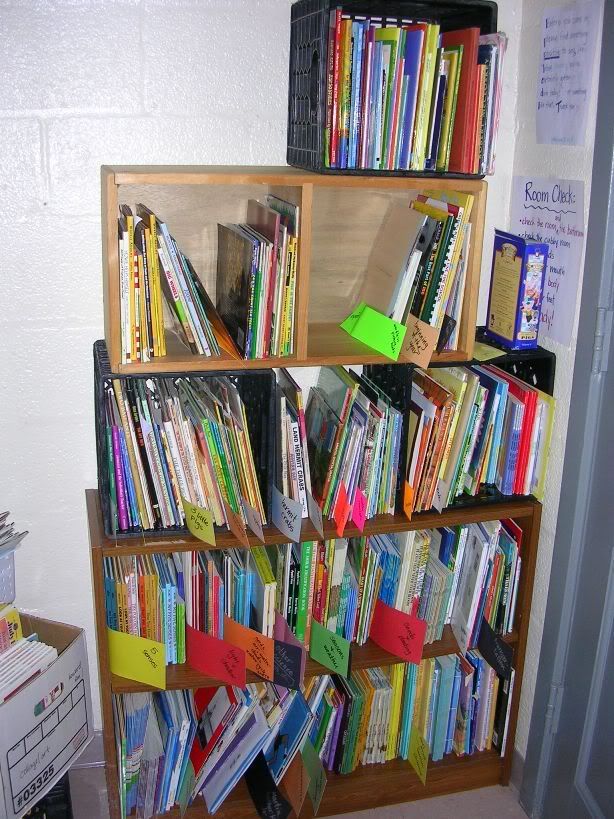
I still have about two-three more hours of work left on books, but I did a lot today, so yay. :)
I threatened in my last post that I'd talk about some of the different areas of the classroom. Today I wanted to mention the circle/meeting area...
For the past two years, this area of the classroom has always been rich and wonderful. It's always one of my favorite areas because we read aloud here, we practice, we discuss hard things, we have morning meeting, we have visitors, we learn about each other, we cry and laugh and dance and sing.
It's like... well, it's the heart of our classroom.
Last year I regularly felt like we were outgrowing the space. The kids would develop a really deep interest in something and we'd fill a book basket and then have nowhere to put it. The projector cart that lived in the middle of the room (that I connect to the laptop to project images/videos/powerpoints/demonstrations, and etc...) was always in the way. When we would have a lot of visitors to our circle, we wouldn't have room for everyone to fit comfortably. And, really? That can't happen.
If the essence of what I believe is 'less is more,' well, then I have to practice what I preach. So, I've modified things a lot. Here is a shot of the meeting area from the windows:
[click to make larger]
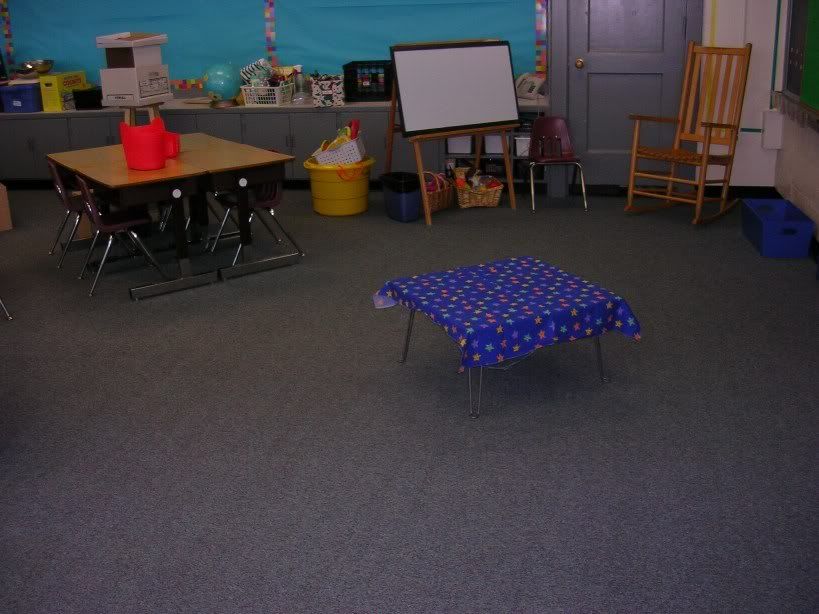
Here it looks really empty. Really empty. But what I really see is the freedom for movement, the areas that we will be able to fill with book baskets (at the base of the table with the red buckets, to the right of the rocking chair, on top of or under the little square table in the center).
I start the year with an "undressed classroom." It's pretty and welcoming, with color and pretty lights and lamps and homey touches, but it generally looks sort of empty. The reason? We build the classroom together, the kids and I. We explore all of the materials we're going to use together, we talk about how we can use them, how to take care of them, and where we're going to put them. In October, the meeting area is going to be a lot fuller, in February, it's going to look totally different, because it will evolve based on the needs of our class. But right now? I don't know the exact needs of our class. So we get to figure it out together.
I'm also going to show you something else:
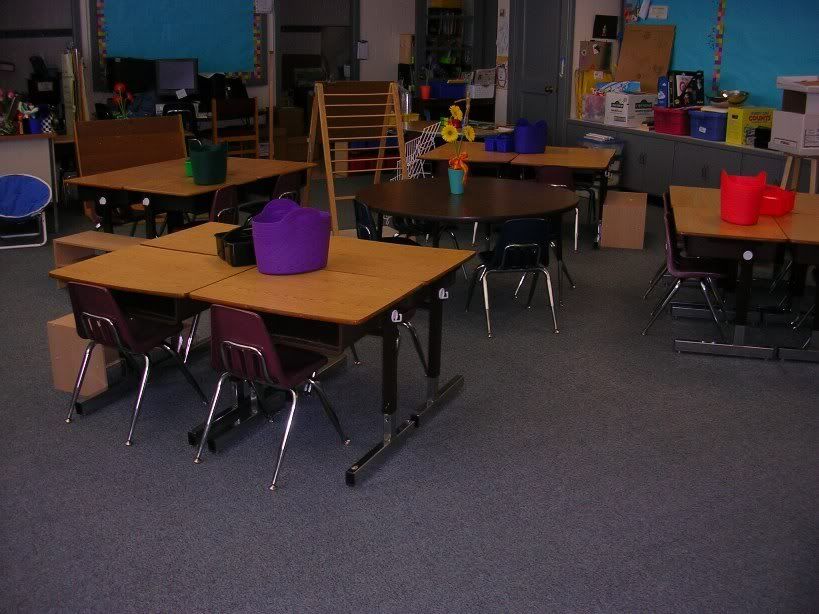
If you look between the "tables" with the purple baskets and the red baskets, you'll notice there's a walkway and a circle table. This is deliberate. For the past two years, I've always had something between those tables, and it's always been in the way. Last year, it was our projector cart. We use it a lot, but not enough for it to be in such a prominent position in the classroom. So, I moved it. I put it here:
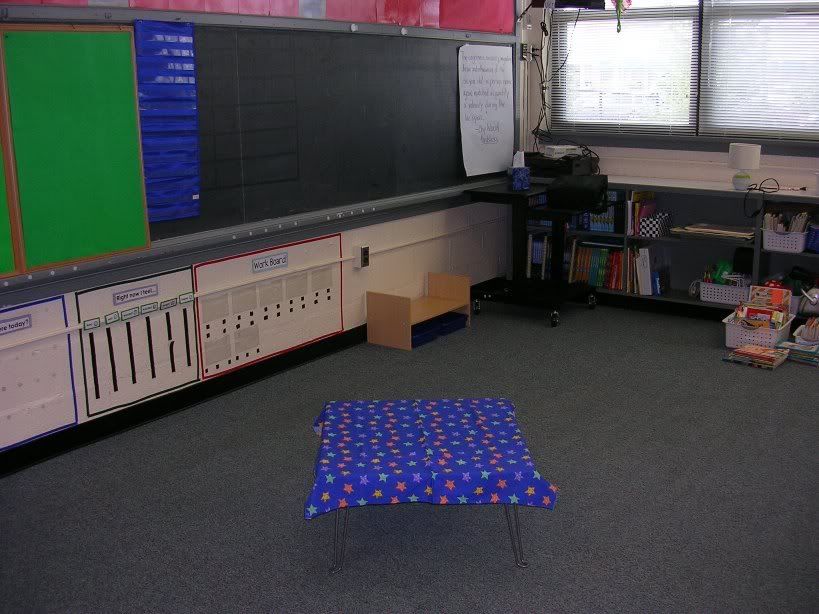
Can you see it? It's the black cart in the far corner under the window. I took out one entire table that we used to use for the listening center and replaced it with the very small, wood colored shelf that we'll use for the listening center. The projector cart is out of the way, near a space that doesn't get a lot of traffic anyway, and fully accessible for when we need it on a regular basis.
I am so pleased. This is going to make the shelves with book baskets more accessible AND as I've removed some of the furniture from the meeting area, we now have more wall space to display our work.
Seriously, I'm just completely jazzed about this. I can't wait to watch how this space evolves.
Chances are, I'll continue to babble about some other areas of the classroom -- is there anything you are interested in hearing?
Subscribe to:
Posts (Atom)


 Posts
Posts